Key takeaways
- It is a CV, not a résumé — 1–2 pages is normal.
- Personal Profile opens the page (2–4 lines).
- CAR bullet framework — Context, Action, Result.
- Dates right-aligned on every entry.
- Final classification (predicted or actual) goes in Education.
- No photo, no DOB, no marital status.
Format rules at a glance
- Document type
- CV, not résumé
- Length
- 1–2 pages
- Personal Profile
- Yes, 2–4 lines at the top
- Bullet framework
- CAR — Context / Action / Result
- Dates
- Right-aligned
- Photo, DOB, marital status
- Never
Introduction
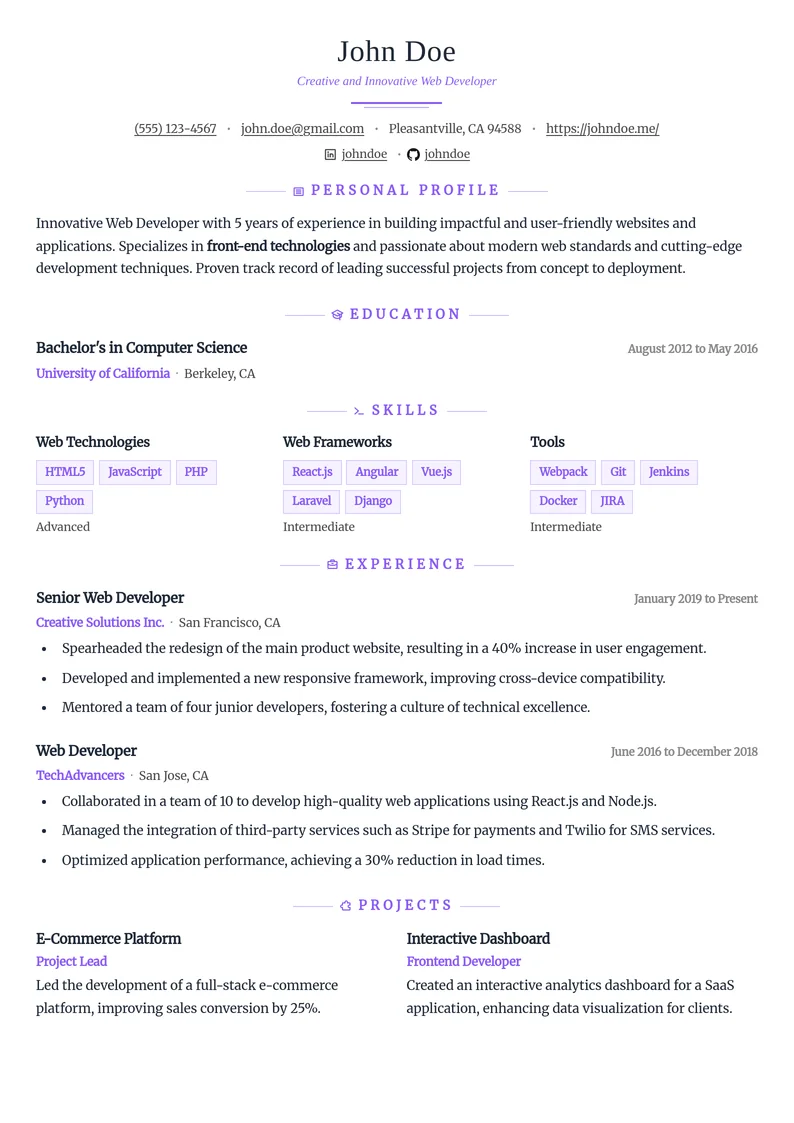
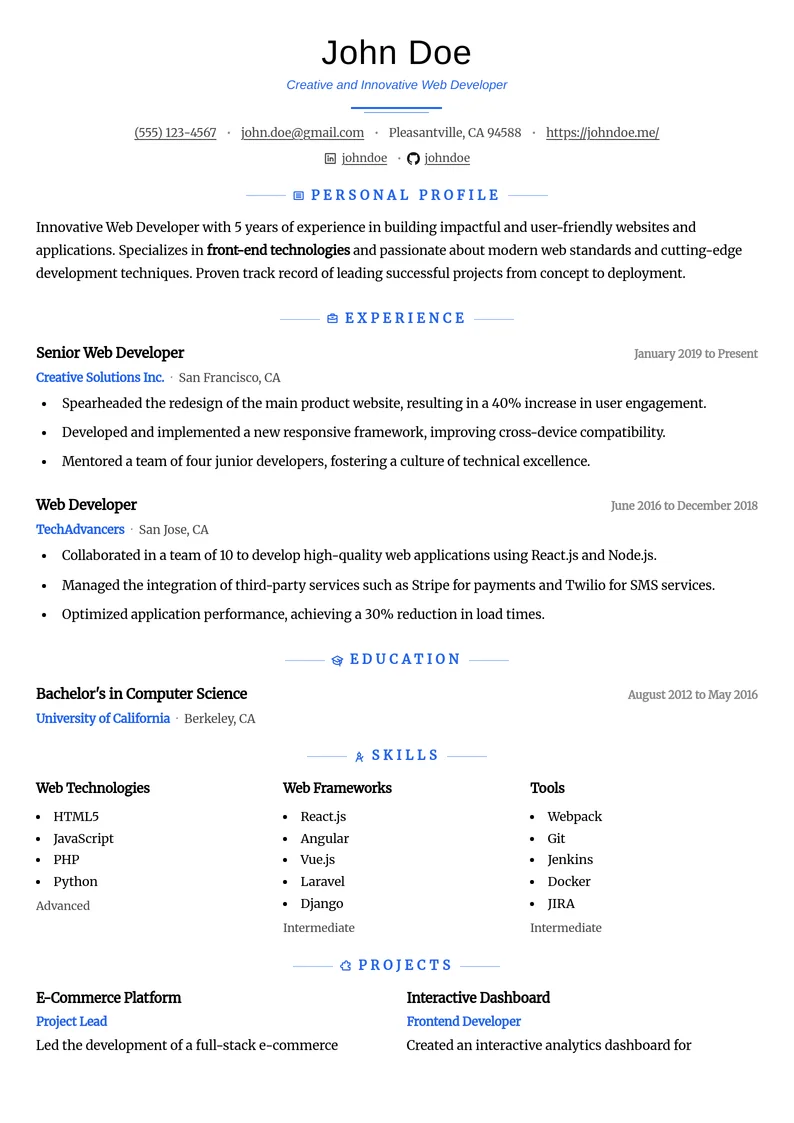
An Oxford CV looks different from a US resume from the first line. It is called a CV (curriculum vitae), it can run to two pages, it almost always includes a short Personal Profile at the top, and dates sit on the right-hand side of every entry. The Oxford Careers Service teaches a CAR-framework bullet (Context, Action, Result) and emphasizes that British recruiters read CVs more slowly and more sceptically than US recruiters skim resumes — every claim should be specific enough to defend at interview.
This template gives you the Oxford CV skeleton: a Personal Profile slot, right-aligned dates, and conservative typography that reads correctly to both UK employers and applicant tracking systems.
Oxford resume format
- Length: 1–2 pages for undergraduates and most professional applications; an academic CV runs longer.
- Font: a clean sans-serif (Arial, Calibri) or readable serif (Garamond), 10–12 pt body.
- Margins: ~1.5–2 cm.
- Dates: right-aligned, on the same line as the role/degree title.
- Layout: single column. UK ATS systems behave the same way as US ones — no tables, no boxes.
- Photo: none for UK applications.
Personal summary
Oxford CVs typically open with a 2–4 line Personal Profile: who you are professionally, what you specialise in, what you're looking for. The Careers Service uses this section deliberately to give the recruiter context before the rest of the document.
- Write in third person without using your name ("Final-year PPE student with experience in policy research…").
- Mention sector, technical or analytical specialism, and the type of role you want.
- Don't restate your full CV — set it up.
Experience section
Oxford teaches the CAR bullet structure:
- C — Context: what was happening (project scale, team size, business problem).
- A — Action: what you specifically did (verb-led).
- R — Result: the outcome, ideally quantified.
Cap each bullet at two lines. List 3–5 bullets per role, ordered by impact rather than chronology. Use past tense for completed roles and present tense for your current one.
Education and certifications
Education leads the CV until you've been out of Oxford for several years.
- University of Oxford, then degree (e.g. BA Hons in Philosophy, Politics & Economics), then graduation date (right-aligned).
- Include final classification (or predicted) — 2:1 (predicted) or First Class Honours.
- List college (e.g. Balliol College) on a sub-line.
- Modules / dissertation / thesis title beneath, two to three lines maximum.
- A-Levels and GCSEs go below in compact form for current students; remove them after 2–3 years of work.
Skills guidance
Skills sit toward the end of an Oxford CV. Group by category — Technical, Languages, Certifications — and use language reflective of the Common European Framework (A1–C2) rather than self-declared fluency claims. UK CVs lean specific: name the software, the analytical method, or the qualification.
Mistakes to avoid
- Calling it a "résumé." In the UK it is a CV, even when it is one page.
- Left-aligning dates. Right-alignment is the UK convention.
- Adding a photo or personal details (DOB, marital status, nationality). UK employers don't expect them and equality legislation discourages them.
- Listing "References available on request." The Careers Service treats this as filler — either include named referees at the end or omit the line entirely.
- Vague Personal Profiles. If yours could appear on someone else's CV, rewrite it.
Frequently asked questions about the Oxford resume format
Two pages is the UK norm for graduates and professionals. One-page CVs are typical only in finance/consulting graduate schemes that explicitly ask for them. Don't shrink margins to force a one-page version — UK recruiters expect to turn the page.
Yes. The Careers Service treats your college as part of your Oxford identity, and UK recruiters often expect to see it. Place it as a sub-line under the degree.
Length and content. An employer CV is 1–2 pages with a Personal Profile and emphasis on transferable skills. An academic CV can run 4–10+ pages with publications, conferences, teaching, and grant history. Don't merge them.
While at Oxford and for the first year or two after, yes — in a compact line under Education. Once you have several years of full-time work, remove them to free up the space.
Career coaching and hiring-side experience, written into practical resume and job-search advice.
Based on public career-center best practices. Not affiliated with or endorsed by University of Oxford.
Source · careers.ox.ac.uk